
You just read about the tangle — the AVM type of Parkes Weber. The AVF type is the more direct version of the same problem.
No tangle this time. Instead, picture a single on-ramp built straight into the residential street, with nothing in between — one direct connection, or sometimes a few, from artery to vein. No maze to slow things down even a little. That directness is the whole difference: an arteriovenous fistula sends arterial-force blood into the vein immediately, and the vein just past that connection often shows it — visibly enlarged, sometimes warm to the touch, sometimes with a pulse you can feel from outside the skin.
Because there’s no nidus to work around, the approach to fixing it is often more direct too: closing the specific connection point itself, whether through an endovascular procedure or surgery, rather than managing a whole tangled network.
See the “Three Mixed Up
— graphic ◈ —
Legacy Syndromes” graphic in the sidebar — the KTS panel shows this layered architecture: capillary, venous, and lymphatic, all slow-flow, all working together to create what you see on the surface.
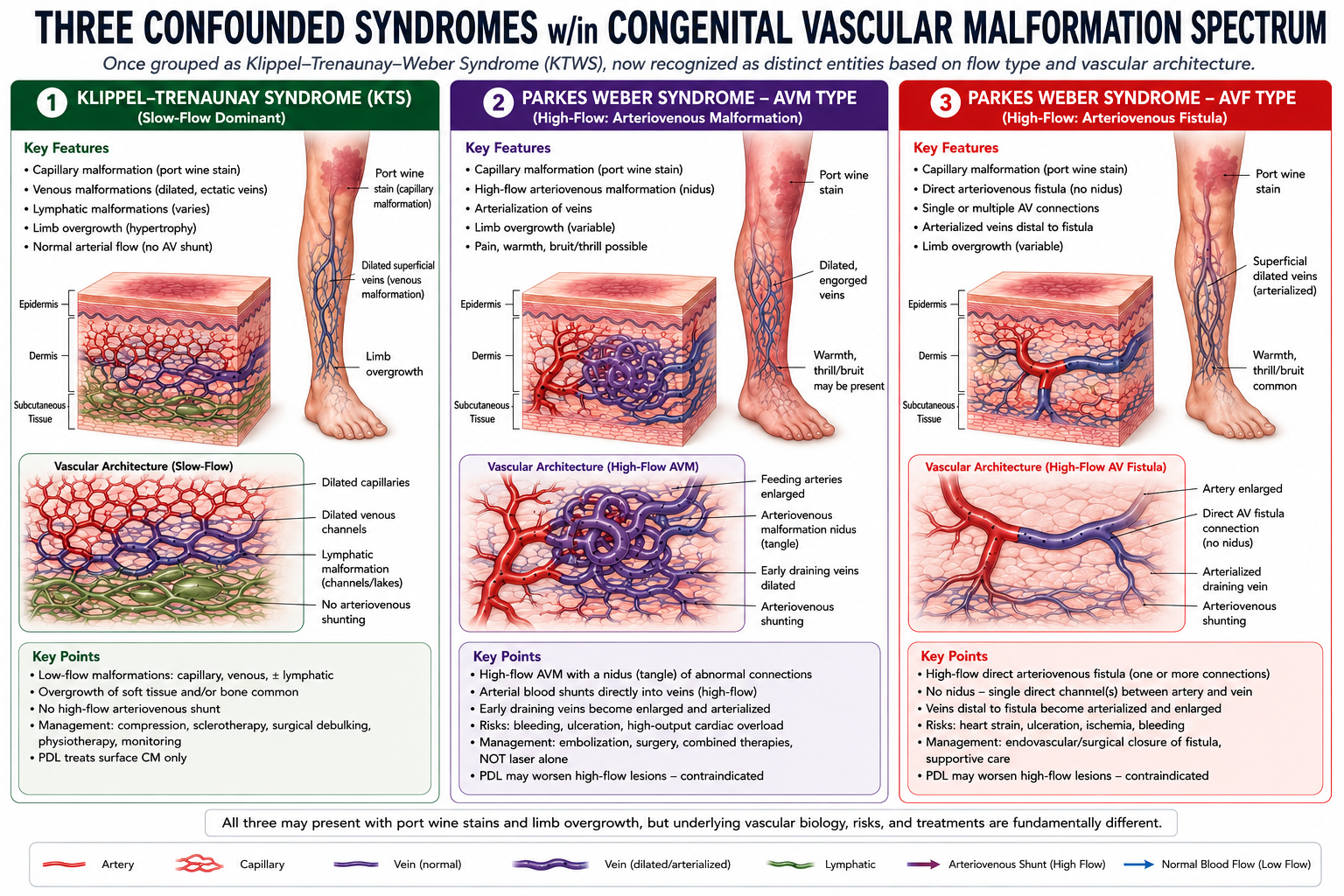
What this means for you: the risks here — heart strain, tissue breakdown, bleeding — come from the same source as the AVM type: the shortcut itself. But because the connection is often more localized, closing it can sometimes be more straightforward once it’s clearly identified on imaging.
Want the full clinical picture? The Compendium has it, whenever you’re ready.